
Greenvolt Power are preparing to submit a planning application to Rugby Borough Council for a proposed solar farm near Withybrook.
The proposed development will contribute to energy security through the provision of local, renewable energy supply. This is enough to meet the annual electricity needs of approximately 27,500 homes.
It will also deliver a comprehensive scheme of landscape and ecological enhancements and contribute to biodiversity net gain in the local area.
Where is the Proposed Solar Farm?
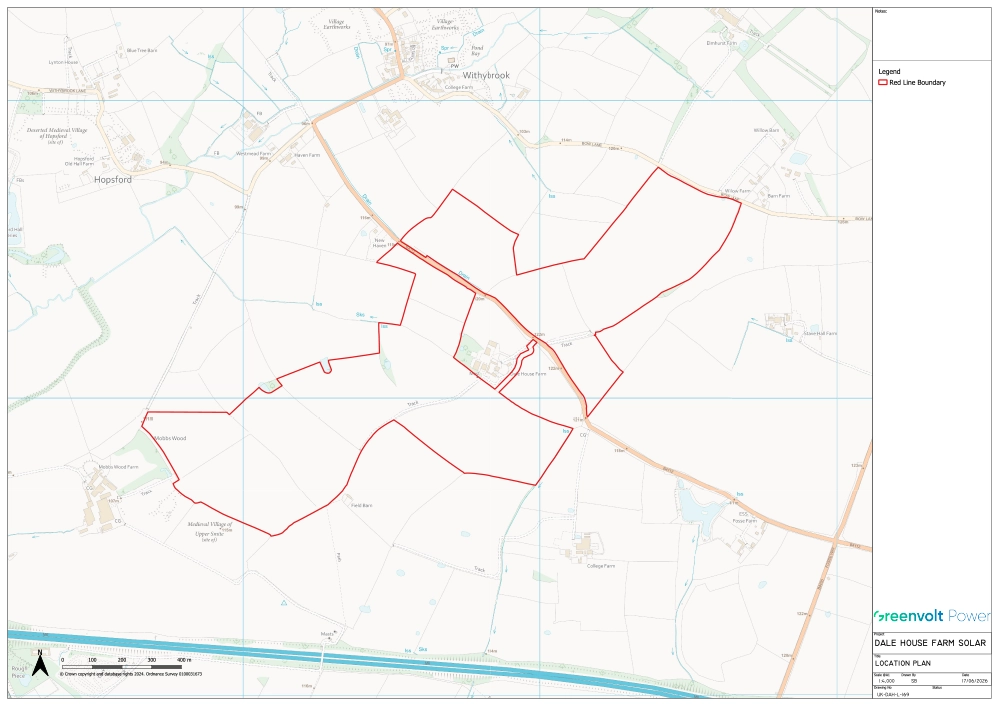
The project is located on land off the Rugby Road (B4112) in Withybrook.
Occupying approximately 92 hectares, the solar farm would have an approximate generating capacity of 75MW.
The temporary nature of the development will allow the agricultural land to regenerate during the period of operation, and the land use will be reversed back to agriculture at the end of the project life.
How Solar Farms Operate
What Are They?
- Ground-mounted photovoltaic (PV) panels
- Panels up to 3.5m in height
- Arranged in rows with space for vegetation
- Temporary and reversible development (typically ~40 years)
How Electricity is Generated
- Sunlight hits the PV panels
- Panels produce DC electricity
- On site inverters convert DC to AC
- Electricity is exported to the local electricity network
Electricity connects to the wider network operated by National Grid.
During Operation
- No emissions
- Negligible noise levels
- Minimal traffic required for regular maintenance
Why Solar Energy Matters
The UK Energy Context
The UK is transitioning to low-carbon electricity to reduce emissions and improve energy security, supported by the Department for Energy Security and Net Zero.
Why Solar?
- Clean electricity generation with no operational emissions
- Reduces reliance on fossil fuels
- Quick to deploy compared to other technologies
Key Benefits
- Temporary and reversible development
- Opportunity for significant biodiversity net gain
- Can retain agricultural use
- Supports national energy resilience
Planning Considerations
All solar farm proposals must consider:
- Ecology (including BNG)
- Glint and Glare
- Landscape
- Noise
- Archaeology
- Cultural Heritage
- Traffic Management
- Arboriculture
- Hydrology
- Soils
Each planning application is determined on its own merits, against national and local planning policy.
Landscape & Visual Impact
The solar panels will have a maximum height will not exceed 3.3m metres, allowing the development to sit low within the landscape. Existing hedgerows and trees will be retained and strengthened to provide natural screening.
Landscape Context
The site lies within the Leicestershire Vales National Character Are. This is a large, relatively open, uniform landscape composed of low-lying clay vales interrupted by a range of varied river valleys.
Visibility
A Landscape and Visual Impact Assessment has been undertaken using a Zone of Theoretic Visibility (ZTV) study. Initial findings show:
- Limited visibility from nearby settlements
- Views mainly restricted to nearby roads and footpaths
- Existing vegetation provides natural screening
Seventeen viewpoints have been identified to assess potential views of the development.
Landscape Mitigation
Where necessary, additional planting will be provided to further integrate the development into the landscape, including:
- New hedgerows
- Native tree and grassland planting
- Strengthening field boundaries
Ecology & Biodiversity
Specialist surveys have been carried out including:
- Preliminary Ecological Appraisal
- Habitat Survey
- Breeding Bird Survey
- Great Crested Newt eDNA Survey
These surveys help inform the layout of the solar farm and identify areas that should be protected.
Protecting Habitats
The design of the solar farm includes measures to protect important ecological features:
- 5m buffer zones around hedgerows and trees
- Protection of existing vegetation during construction
Biodiversity Enhancement
Solar farms can significantly improve biodiversity compared with intensive agriculture. Proposed enhancements include:
- Wildflower grassland beneath the solar panels
- Additional hedgerow and tree planning
- Habitat creation for birds, insects and small mammals
- Long-term ecological management
These measures are expected to deliver significant biodiversity net gain.
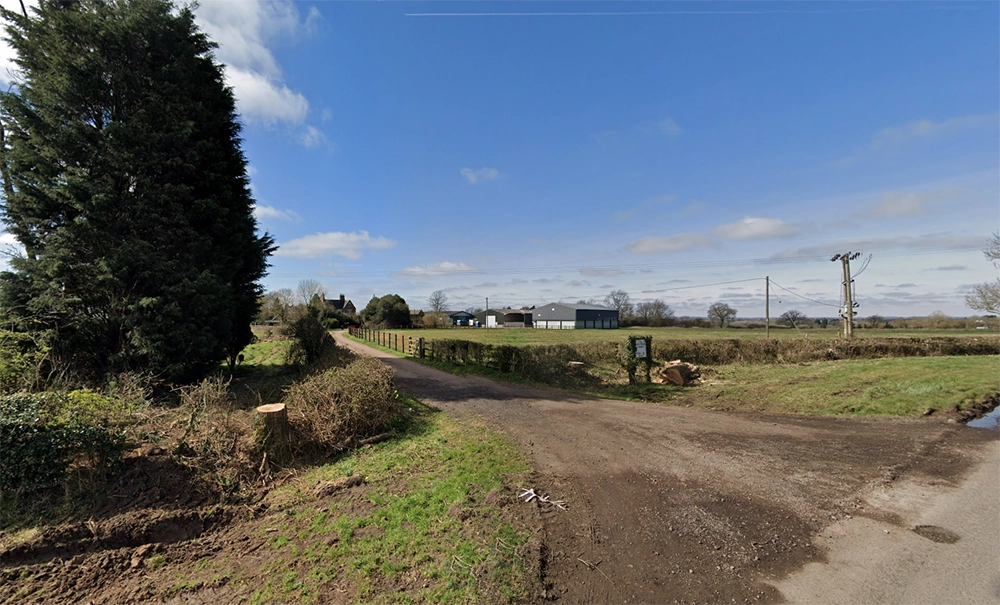
Proposed site entrance into the southern field off B4112
Construction and Access
An existing agricultural access track off Rugby Road/B4112 will be upgraded to form the site entrance into the southern field, as well as internal site access tracks.
A new access into the northern field will be created off of Rugby Road/B4112 to ensure adequate visibility.
The construction phase will be carefully managed through a Construction Traffic Management Plan, and will last approximately 6 months.
Construction traffic is anticipated relatively low, 2 – 16 HGVs per week depending on the stage of construction.
Traffic management measures will be implemented, such as avoiding peak travel times.
Other Technical Matters
Flood Risk & Drainage
The site is entirely within Flood Zone 1, meaning it has the lowest probability of flooding. Solar panels are mounted on piles rather than solid foundations, allowing rainwater to drain naturally. A Flood Risk Assessment and Drainage Strategy will accompany the planning application.
Noise
Solar farms generate very little operational noise. Sound is typically limited to inverters and transformers which convert electricity for export to the grid. A noise survey and assessment has been undertaken to ensure levels remain acceptable for nearby properties.
Glint & Glare
Solar panels are designed to absorb sunlight rather than reflect it. A Glint and Glare Assessment has been undertaken which considers potential effects on nearby homes, roads and aviation receptors.
Agricultural Land & Soils
Indicative Agricultural Land Classification (ALC) mapping indicates the land constitutes predominantly Grade 3b, with incidents of Grade 3a. An ALC survey is being undertaken to confirm results.
Solar farms represent a temporary land use and can allow for continued agricultural use, such as sheep grazing.
Cultural Heritage & Archaeology
An assessment of heritage assets and archaeological potential is being undertaken. Where necessary, surveys or mitigation measures will be agreed with the County Archaeologist.
Next steps

Summer 2026
Planning Submission

Winter 2026
Planning Decision
Give us your feedback
We welcome your feedback on any aspect of the submitting planning application
Please provide your contact details if you wish to receive a response. Any information provided will only be used for informative purposes only and will not be submitted to the council as a formal representation.
1
Step 1

