


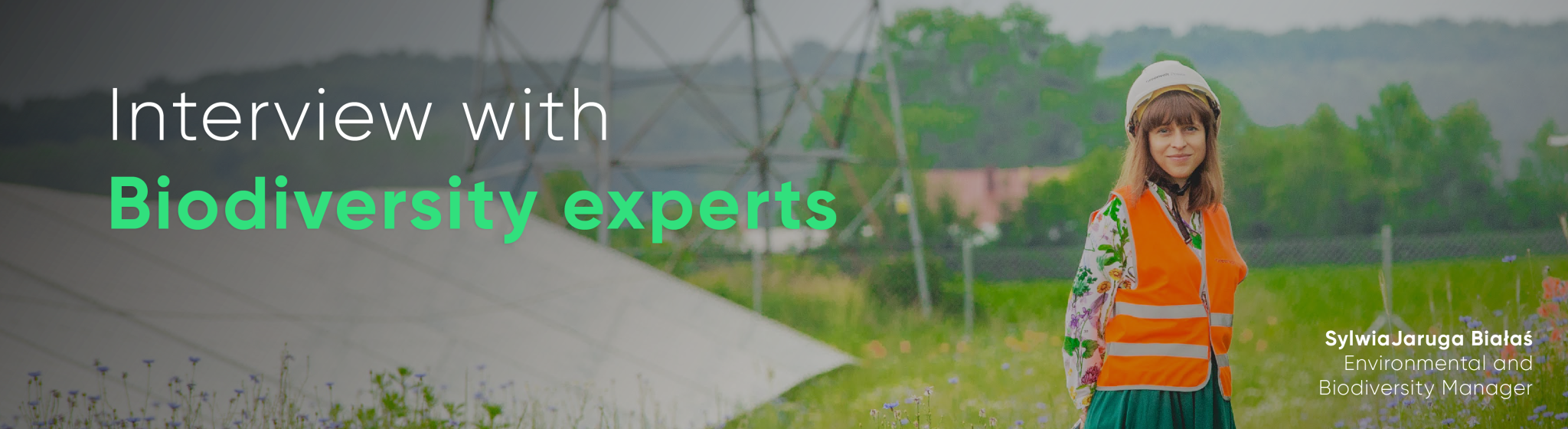
To provide a deeper understanding of our approach to sustainability, our Biodiversity Strategy, and renewable energy development, our expert Sylwia Jaruga-Białaś, offers a comprehensive explanation of how these efforts are implemented in practice, going from the strategic planning and collaboration with local communities to on-the-ground execution.
Why does biodiversity matter in the context of renewable energy development?
That’s a great question and one I believe deserves more attention. While renewable energy is critical for reducing carbon emissions and combating climate change, it’s important to remember that renewable doesn’t automatically mean impact-free. Large-scale solar, wind, or BESS installations, if not carefully planned, can place significant pressure on local ecosystems and biodiversity.
This is precisely why biodiversity plays such a central role in our approach. It’s embedded in our Biodiversity Strategy, where one of the key objectives is to build a “Nature Positive” business model based on the mitigation hierarchy. We apply the mitigation hierarchy (avoid, minimize, restore, and compensate) across all phases of project development: from planning and construction to operation and eventual decommissioning. Additionally, we introduce biodiversity enhancements on operating projects and create partnerships on conservation nature conservation projects. Our ambition is not only to reduce risks and mitigate impacts on nature (“no net loss”), but also to implement solutions that achieve a biodiversity “net gain”.In this way, we don’t just aim to limit negative impacts – we actively contribute to the restoration and protection of ecosystems wherever we operate.
We cannot treat biodiversity as just a box to check. It must be seen as a long-term commitment. Ultimately, our goal is to demonstrate that renewable energy and biodiversity can go hand in hand. We want our projects to support both the climate and nature, because long-term sustainability depends on both.
Why should companies prioritize biodiversity in their renewable energy projects? How do biodiversity and ecosystem restoration add value to renewable energy projects?
I would like to underline that prioritizing biodiversity within a company’s strategy is a smart, forward-looking business decision and a key pillar of long-term value creation.
First of all, when companies shall integrate biodiversity into their operations from the very beginning (as we do), starting with responsible planning and applying the mitigation hierarchy, they’re better equipped to manage risk and seize opportunity. Understanding how our activities impact ecosystems allow us to avoid or minimize damage, reducing the risk of legal issues or pushback from local communities.
Second, biodiversity is becoming increasingly important from an investment perspective. Investors and financial institutions are looking for companies with strong ESG performance. A clear commitment to sustainability, including biodiversity, enhances a company’s profile and credibility. It also improves access to financing, particularly from banks and institutions that now require clear evidence of environmental and social responsibility before funding projects. These expectations are clearly visible, and we observe them regularly during our due diligence processes.
There’s also the regulatory aspect. Staying compliant with EU biodiversity and sustainability regulations, and anticipating future trends, ensures we avoid penalties, but more importantly, it positions us ahead of the curve in a rapidly evolving market.
And finally, there’s reputation and stakeholder trust. Communities, regulators, and partners respond positively when they see that we’re not just building infrastructure – we’re taking care of the environment and listening to local concerns. That kind of trust is incredibly valuable and helps us operate more smoothly, especially at the development stage.
Beyond external stakeholders, this focus on biodiversity also matters internally. It helps shape a company culture grounded in environmental responsibility, which is increasingly important to employees. When people see that their company is acting with purpose and care for the environment, it fosters pride, engagement, and a deeper sense of meaning in their work. It creates a shared identity and strengthens collaboration across departments which I can see on daily basis.
So overall, integrating biodiversity is about reducing risks, improving project resilience, attracting investment, strengthening our reputation, engaging employees, and fostering community support. It’s a win for business – and a win for nature.
Could you give an example of introducing biodiversity enhancements on renewable projects?
Certainly. Each year, we bring biodiversity-focused action to a different renewable project in Poland, transforming these sites into biodiversity hotspots. This initiative is a key element of Greenvolt’s culture and Biodiversity Strategy, driven by our commitment to nature-based solutions.
Recently, on May 13th, at our Solar Farm Karnowo we introduced a number of long-lasting, nature-based solutions aimed at restoring the area’s ecological richness.
This was a volunteering effort, carried out together with colleagues from various departments and our partner Forest Maker. As part of the initiative, we planted a Miyawaki microforest consisting of nearly 600 trees and shrubs representing 36 native species. To support pollinators like wild bees and butterflies, we also created a herb-rich garden with 11 native species and over 250 seedlings, which attract insects and, in turn, help sustain birds, bats, and other wildlife. We built a sandarium, a small micro-dune that mimics natural sandy habitats, to support ground-nesting pollinators such as wild bees, 65% of which nest in the soil. To further enhance the site’s ecological value, we added animal shelters, including dry stone walls, pebble piles, and gravel belts, offering hiding and breeding spaces for various species. We also introduced dead wood, such as logs and stumps, which support around 40% of forest biodiversity, and we drilled holes in stumps to improve nesting opportunities for bees, beetles, and butterflies. Finally, we installed a protected nesting box for the hoopoe, a rare and iconic farmland bird.
Thanks to the dedication of volunteers from across Greenvolt (we even had a volunteer join us from the USA!) we turned strategy into hands-on action, proving that real impact begins with people.
In my opinion, initiatives like this are at the heart of what sustainability truly means.
Are we currently involved in any other biodiversity projects?
Yes, we’re actively engaged in initiatives aimed at protecting valuable ecosystems, and we’re excited to share that we’ve just launched a new restoration project. The three-year program is being carried out in partnership with UNEP/GRID-Warsaw, an NGO affiliated with the United Nations Environment Programme. The on-the-ground fieldwork will be conducted by the Polish Society for the Protection of Birds (PTOP), with funding provided by Greenvolt.
This project – part of the Re:Generacja program (https://re.generacja.org) – is especially meaningful because it takes place in the same region where Greenvolt Power is developing the Turośń Kościelna BESS project. Although it is an off-site initiative, it will have a positive impact on local biodiversity in the area where we operate.
The initiative focuses on preserving open wetland habitats, which are critical breeding grounds for many valuable shorebird species. Planned activities include mowing, removing shrubs, and eventually introducing the Konik Polski, a primitive Polish horse breed, to help maintain the habitat through sustainable grazing.
We recognize that our operations, particularly wind farms, can affect local wildlife, especially bird populations. That’s why we are committed to supporting projects that improve conditions for avifauna on a broader scale.
In addition to this, we’re continuing our involvement in the “Adopt a Meadow” initiative (https://adoptujlake.pl/) . As part of this project, we support the restoration and protection of a 10-hectare meadow located in a Polish landscape park. Through a combination of financial support and employee volunteering, we contribute to the active conservation of this valuable habitat, which is threatened by invasive species and biodiversity loss.
This year, we’re also supporting carbon sequestration studies on meadows, a topic we find particularly meaningful, as similar meadow habitats exist on several of our operating project sites.
Both of these initiatives are fully aligned with our Biodiversity Strategy, which includes a key objective to promote partnerships that enable effective biodiversity management, conservation, and restoration and that’s exactly what we’re doing.

