


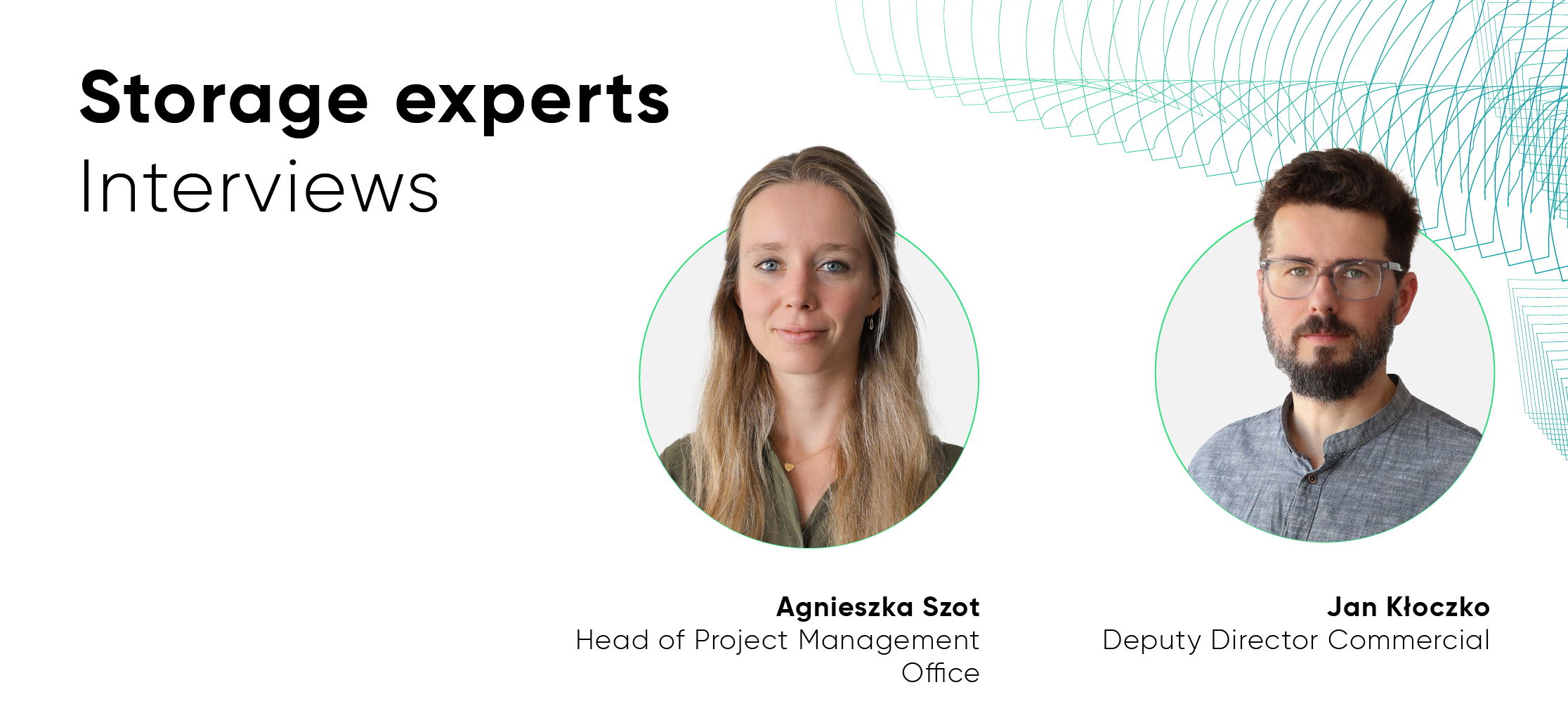
At Greenvolt Power, we are committed to driving innovation in the energy storage sector. To provide deeper insights into our latest developments, we have gathered our storage experts—Agnieszka Szot, Head of Project Management Office, and Jan Kłoczko, Deputy Director Commercial —to discuss the recent agreement with BYD Energy Storage. This partnership marks a significant step in the development of large-scale battery energy storage projects in Poland, with up to 1.6 GWh in capacity. In this interview, our experts share key updates on project progress, market trends, and Greenvolt’s role in shaping the future of energy storage.
When did construction on both projects begin?
The construction of the HV substation already has been initiated on both projects and will follow with BESS beginning of construction in Q2.
What is the function of these two projects: arbiratrage, capacity market contracts, or something else?
Key function is to support capacity market as the auctions are won. Nevertheless, arbitrage and ancillary services are also in our scope of interest.
What other BESS projects is Greenvolt developing in Poland?
Greenvolt Power is developing several different BESS projects, stand-alone as well as hybrid with PV and Wind (mainly with PV). Our projects vary in size from 10 to 300 MW and are located across whole Poland.
What portfolio of storage projects in MW/MWh are you currently developing in Poland, and for what capacity have you secured participation in the capacity market?
In the capacity market we have already secured 1.6 GW, additional in development we have an extensive pipeline which can be counted in GW.
How long does it currently take on average, to prepare an energy storage project in Poland for obtaining a building permit?
Around 3 years.
How does Greenvolt plan to optimize the use of its energy storage assets to maximize profitability?
So far, Greenvolt Power proved very successful in securing revenue base from available support mechanisms in Poland, Hungary and recently the UK. We took the risk of moving aggressively forward when the battery storage in mainland Europe was making its first steps, which benefitted us with acquiring know-how and streamlining our processes earlier than most of the market.
The structure of teams allows for a quick sharing of lessons learned between the markets and building on the experience and track record, and to optimize the cost of procurement. Additionally, Greenvolt Power as the investor in many European and not only countries, is constantly building up own procurement strength. Based on the business relations, being more knowledgeable about storage solutions, optimization in sizing, customizing technology might also bring additional values for the asset.
What energy storage technologies (e.g., lithium-ion batteries, flow batteries, others) are being considered for your projects, and why?
The energy storage space is one of the most rapidly developing industries currently in the world. As of today, we focus on lithium-ion batteries, but we are periodically reassessing the technology landscape not to miss an important technology shift or use of other technologies that could be beneficial from the point of view of Greenvolt’s goals.
Moreover, each storage technology has its pros and cons, meaning that technology must be chosen and adjusted for the usage purpose. Lithium – ion is currently the most advanced one, commercially reasonable, but we believe that natural tendency would be adding other solutions to make storage applications better customized for the market needs.
What challenges do you face in obtaining building permits for energy storage projects, and how did we deal with them for example in this case?
First and foremost, we are dealing with a relatively new type of facility, and authorities do not always have clear procedures for handling them. As an investor, we strive to ensure that the permitting process – including building, environmental and zoning permits – is carried out in close collaboration between Greenvolt Power and the authorities. By fostering a cooperative atmosphere, we create opportunities for constructive discussions and for addressing any uncertainties related to planned battery energy storage systems.
Additionally, we are continuously learning. With the experience gained from obtaining multiple administrative approvals for BESS, we systematically analyze each case and draw lessons from past challenges. This ongoing process enables us to be better prepared for both current and future projects.
What business models for energy storage seem to be the most profitable in the Polish or European markets?
While the Polish market is still at its inception, there are clear lessons that we can draw from the more mature markets. The key lesson is: the real strength of battery storage lies in its flexibility. Focusing on a single revenue line is limiting the ES profitability; the real potential lies in the optimization, or juggling between various available revenue streams, depending on their economic attractiveness at a given moment. In Poland that means tapping into the Balancing Market including ancillary services, performing arbitrage on the Day-Ahead and Intraday market and improving the result by taking advantage of the Capacity Market or state support fund.
What initiatives is Greenvolt undertaking to raise awareness about the importance of energy storage in the energy transition?
Greenvolt Power is actively participating in different panel discussions, conferences to share knowledge and experience with other market players. Besides this, some local initiatives with communities are being periodically organized as to educate and raise awareness among people living nearby renewable energy facilities.

