

Growing energy needs, infrastructure tensions, new EU and national regulatory frameworks, include reference to sustainability, and new expectations from investors, society and public opinion. It is in such realities that today contracts are negotiated that are changing the energy landscape of regions on both a national and European scale. Greenvolt Power, a leading company operating in the segment of utility-scale (wind, solar and energy storage), responsible for the recent sale of multiple projects in Poland in transactions exceeding €300 million – including the Pelplin wind farm and Sompolno, the country’s first hybrid RES project – shows what the practice of green business looks like behind the scenes. Radek Nowak, Greenvolt Power CEO, talks about experiences and strategy.
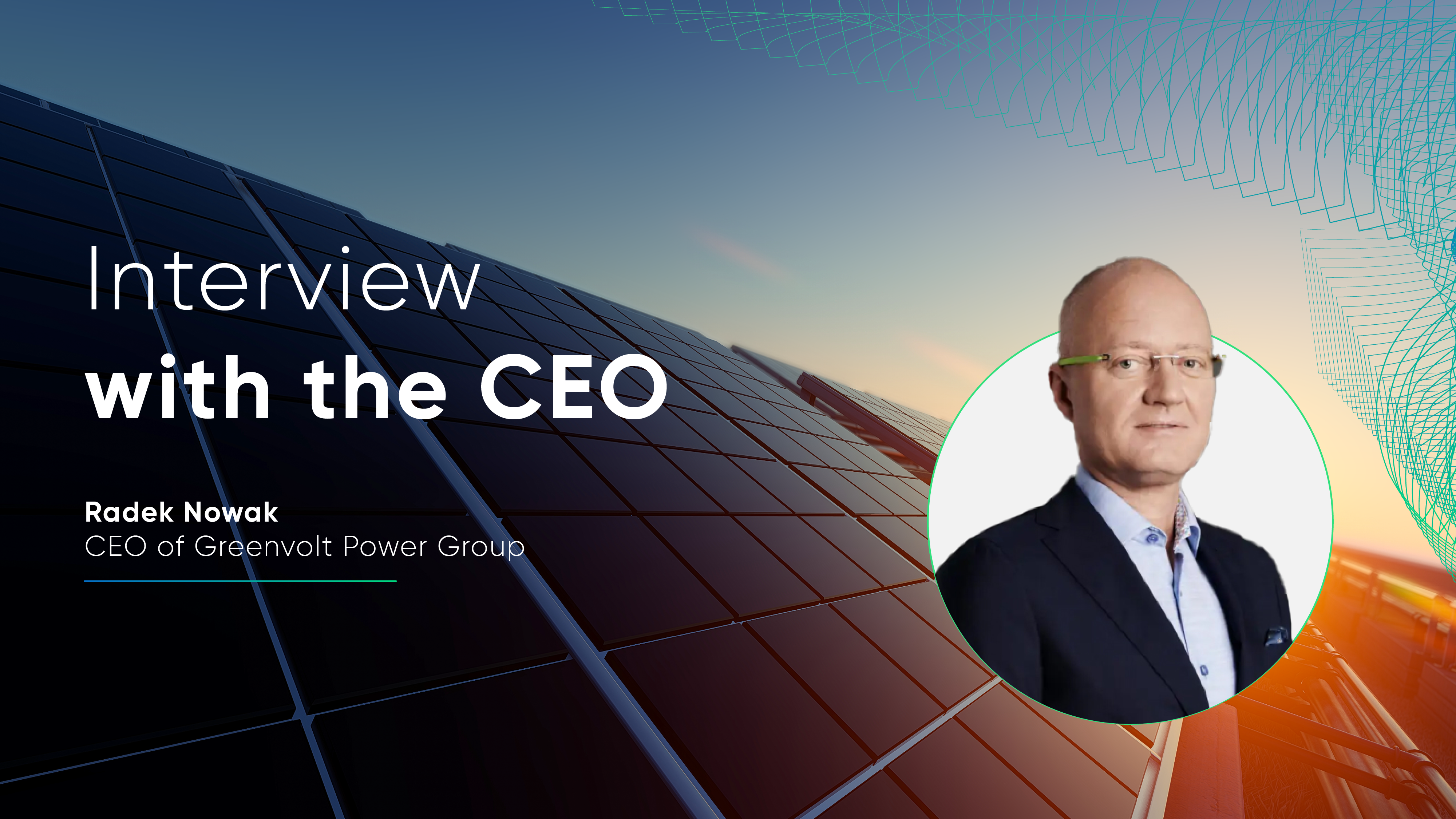
In recent weeks, Greenvolt Power Group finalized the sale of three large RES portfolios in Poland – the wind farm in Pelplin, the hybrid complex Sompolno and the recent wind portfolio of four different projects. What role do such transactions play in your strategy today and what do they say about the evolution of the renewable energy market in Poland?
In Poland, where the Group has operated for over 18 years through what is now Greenvolt Power, its Utility-Scale portfolio includes 731 MW of wind power, 1,878 MW of solar PV, and 2,712 MW of battery storage capacity, positioning Greenvolt as one of the leading renewable energy developers in the country and at a European level. Operations in the utility-scale sector, large-scale farms and RES projects, are the main goal of our long-term strategy. The sale of the Pelplin wind farm (83.2 MW), the hybrid complex Sompolno (26 MW wind, 10 MW PV and 3 MW energy storage) and the most recent wind portfolio are key examples of our asset rotation strategy, which remains fully intact, foresees the sale of around 70% to 80% of the assets we originate. Through these transactions, the Greenvolt Group raised nearly more than EUR 300 million, which confirms the effectiveness of our business model based on the development and commercialization of high-quality RES projects. This milestone additionally strengthens our position as a leading player on the European renewable energy market, particularly in Poland, where our pipeline is maturing, gaining value, and becoming increasingly attractive to institutional investors.
The group you are part of operates exclusively in the RES sector. What does such a model mean in practice, both for institutional partners and local communities?
Focusing exclusively on renewable energy sources allows us to fully dedicate our expertise and resources to high-impact projects that drive the energy transition and deliver long-term value.
For institutional partners, it means cooperation with an entity with a clearly defined profile and mission – one that is fully aligned with the growing demand for sustainable and forward-looking investments. This clarity enhances transparency, strengthens trust, and positions us as a reliable partner in long-term value creation.
For local communities, our projects bring benefits in the form of new investments in infrastructure as well as educational and environmental activities, through which we support the protection of local ecosystems. Our projects go beyond clean energy production. Creating shared value locally is a key aspect of our approach, as well as on ensuring transparency around what we do, why it matters, and how we operate.Sustainability is a fundamental pillar of Greenvolt, not as a trend, but as a strategic conviction. We know that sustainability requires consistency, long-term vision, based on evidence and responsibility. In 2024, Greenvolt’s shareholder structure changed with the entry of KKR, who’s demonstrates a high degree of demand and commitment in ESG matters, which allows us to further strengthen our ambition in these areas.
The focus on Central and South-Eastern Europe is a strategic decision. What distinguishes these markets and what opportunities do they create for the development of renewable energy?
The regions of Central and South-Eastern Europe are characterized by dynamic economic development and growing demand for clean energy. Additionally, there is great potential here for the development of RES projects – in wind energy, solar energy, and energy storage. Our presence in these regions, especially in Poland allows us to take advantage of local resources and support the energy transformation in these countries, which is much needed in the current situation. We are well-positioned to succeed in these regions thanks to a strong alignment between market opportunity, our global capabilities, and deep local expertise. This synergy allows us to implement our strategy effectively and deliver impactful, long-term results.
You are active in the wind, photovoltaic and energy storage sectors, and recently there is increasing talk about hybrid projects. Is this the direction that will define the future of efficient energy in Poland?
Hybrid projects combining different renewable energy sources, namely with storage systems, are the global direction of efficient energy. We view hybridization as a strategic evolution. By integrating technologies such as wind, solar, and storage, we can significantly increase the value of our assets. Storage, in particular, plays a crucial role by allowing us to manage intermittency, balance supply and demand, and provide energy when it’s most needed.
Our project in Sompolno, the first of its kind in the country, is a prime example of this approach. It combines all technologies, demonstrating how hybridization can maximize efficiency and increase asset value, and improve overall profitability, for us and for all stakeholders involved. As part of an international group, we have the capability to tailor each project, whether single-technology or hybrid, based on local needs and detailed case-by-case analysis.
As energy markets evolve, how is Greenvolt Power leveraging energy storage to stay ahead and lead innovation in the renewable sector?
Energy storage lies at the core of the innovation driving the next phase of the energy transition, also in Poland. At Greenvolt Power, we see it as a key enabler — not only for integrating more renewables into the grid but also for unlocking new business models and revenue streams. We’re using storage to move beyond traditional power generation, enabling us to offer grid services, participate in balancing markets, and deliver dispatchable clean energy — all increasingly valuable in today’s volatile energy landscape.
This positions us not just as a developer, but as a flexible energy solutions provider. Thanks to early investments, deep technical expertise, and a forward-looking strategy, we’ve built one of the most advanced and scalable energy storage portfolios in Europe.
Our leadership in this field is demonstrated by our ability to deliver complex, high-performance storage solutions across multiple markets. By integrating storage into our hybrid projects and aligning it with our asset rotation model, we’re developing future-ready assets that meet both market demands and stakeholder expectations.
You have just signed one of the largest battery energy storage agreements in Europe – with BYD, for 1.6 GWh in Poland. What does this mean for the market and at what stage are these investments?
The agreement with BYD Energy Storage covers the supply and implementation of energy storage systems with a total capacity of 1.6 GWh in two locations in Poland: Turośń Kościelna and Nowa Wieś Ełcka. Both projects, with a capacity of 200 MW each, are already in the infrastructure construction phase. Deliveries for both projects will begin in Q4 2025, with completion scheduled for Q1 2026. This is our largest contract of its kind in Poland and in Europe, which highlights our role as a leader in the development of energy storage infrastructure in the region. It also shows how to realistically implement the tasks and challenges of modern renewable energy. Energy storage is one of the fastest growing technologies in the world, becoming an essential element of the energy mix in the country’s economy.
Read more about the contract
In the context of such large projects, what do contract negotiations look like today in the RES sector? What do partners expect, how is the balance of power changing, and what role does business credibility play?
Contract negotiations in the RES sector are becoming increasingly complex due to growing requirements for supply stability, grid integration, and environmental and social aspects. Partners expect transparency, solid planning, and experience in project implementation. At the same time, fast turnaround times and adaptability to changing conditions are required, which is why having a background of experience and knowledge about new technologies is an important element during negotiations and contract implementation, and we have them. Business credibility, supported by successful implementations and long-term contracts – such as our 17-year capacity market agreements – is key to building trust and acquiring new partnerships.
You carry out not only energy investments, but also educational, social, and environmental activities. What does the practical combination of big business with local responsibility look like.
We see local responsibility not as a separate initiative, but as an integral part of our business strategy and we believe that farms can not only produce clean energy but also support local ecosystems and become nature-friendly places.
That’s why we focus, among other things, on creating habitats, supporting pollinators, and enriching the natural environment around our sites. Among our specialists we have experts in biodiversity and environmental protection, ensuring that sustainability is embedded from planning to execution.
Cooperation with local entities and support for communities is one of the core values of the entire Greenvolt Group, of which we are a part. We conduct various types of educational workshops, support local events not only financially, but often through our active participation, are they are also designed to build trust and foster long-term partnerships. We often organize employee volunteering programs, which allow our teams to actively participate in activities for local communities. We are involved in programs supporting biodiversity protection and environmental education.
The year 2030 is, for many companies in the industry, the moment of reckoning with climate ambitions. What are your strategic goals and what might still surprise the market?
Our strategic goal for 2030 is to significantly increase the share of renewable energy sources in the energy mix, through the development of wind, solar and energy storage projects. Our activities will focus on creating a sustainable and resilient energy system, namely in Polan, that meets the challenges of the future – challenges we are already witnessing and cannot ignore. Our strategy is to consolidate and growth and work with the latest technologies so that we can offer innovative solutions to the market as soon as the demand for them arises. This approach has proven effective in our energy storage projects – and we want to continue on this path
Interview granted by Business Insider

